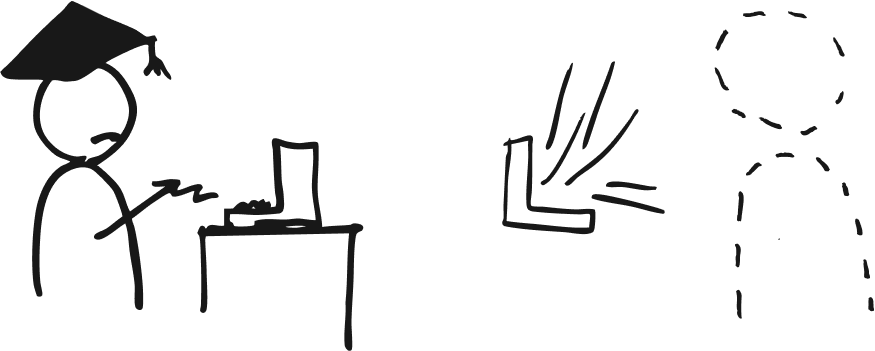
Luca
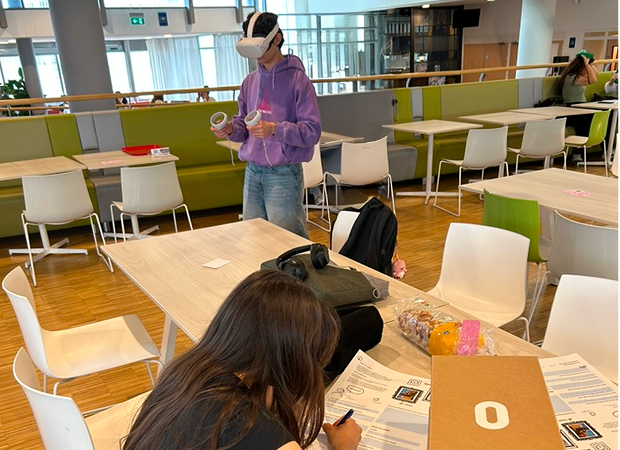
Luca and a friend were waiting in the Randwijck canteen, where they had 2 hours to kill before their lecture. We had cookies, stroopwafels and an opportunity for distraction. A match made in heaven!
Who is Luca?

Creative
Bubbly
Hungry
Realistic
Luca
Studies Biomedical Sciences
22 years old
From Spain
“I am an extrovert that gets along with introverts”

Brainstorming
In order to gather valuable stories and insights to shape our VR solution, we had to collect a little more information on the students’ curriculum. What do they do exactly, what drives them, and what do they think is lacking? Finding out their wants and needs. We guided participants with and without VR experience in exploring different applications and had them share their thoughts through guided questions and a short brainstorm. Here is a short passage:

"I think I'd prefer practicing VR alone. Group sessions are often chaotic. Imagine a whole class trying to do the same thing at once. It would be a mess."

"Agreed. I'd rather do it at home or in a quiet space. But what annoys me is that now, lots of things are just explained with words. It would be great to see cells or molecular processes in 3d."

"That would be cool! If I can see it, I get it instantly."
Let's get drawing
We believe that drawing helps unleash creativity that might not come up otherwise. We asked them to think of their wildest VR-dreams. Even though we kept getting the same reaction, “I can’t draw!”, they thought up fascinating and innovative ideas. Afterwards, we analyzed the drawings and sketches, and based on them, we created new illustrations that tell the story they wanted to express. The sketches weren’t the final result, but a tool to spark creativity. If you would like to see the drawing Luca made, click here.

Inside Luca's imagination
Course Luca believes needs change: Biomedical Approaches
The course Biomedical Approaches teaches key skills in biomedical sciences, such as research methods, data analysis, and lab techniques.
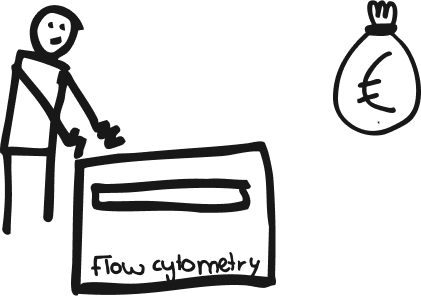
One of the skills students learn is Flow cytometry (FC). This is a technique used to detect and measure the physical and chemical characteristics of a population of cells or particles (e.g. looking for cancer cells). However, this process is very expensive.
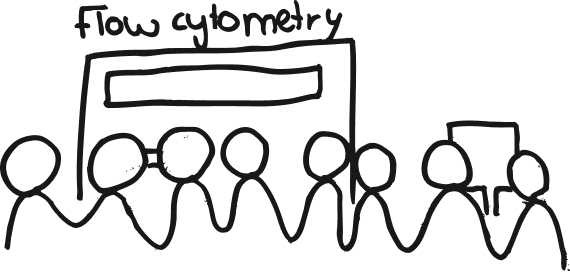
That’s why students now often observe experiments with larger groups, watch videos about the process, or read stories that explain it instead of performing the procedure themselves.
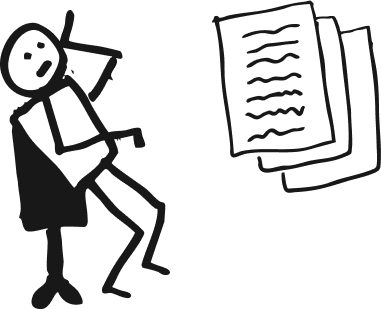
The students were frustrated with certain procedures they couldn’t try themselves and could only observe, which made the material feel too abstract and difficult to understand. They said that if they could actually try these procedures, they would be able to grasp them more quickly and easily.
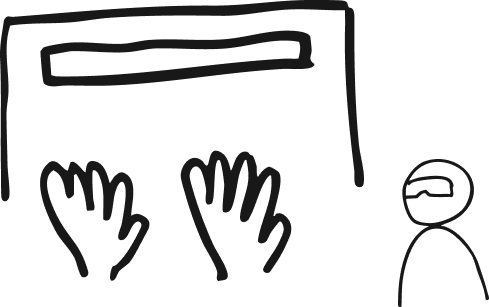
The solution: A VR experience in which the students can choose an experiment to rehearse, so this can be played individually, almost anywhere. This reduces the needed resources so that everyone can try everything.

Long story short
What if students could actually rehearse complex lab procedures whenever and wherever they want? That’s where virtual rehearsal comes in. Instead of just watching or reading about flow cytometry, they could actually try it, without the expensive equipment or crowded labs. By creating a VR experience where students can explore, repeat, and interact with biomedical experiments, we open the door to contextualized learning. It’s no longer just theory, it’s something they can step into. With focused immersion, distractions fade away, and understanding clicks faster. We wanted to give them extraordinary abilities: zoom into cells, walk through molecular processes, or replay that one tricky step until it makes sense. And because it’s all in VR, students can experience this remote presence from home, the library, or wherever they feel most focused.",
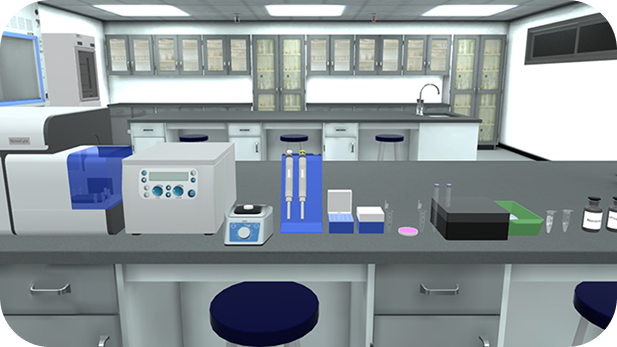
While researching, we found an app that really resonated with Luca's idea.
Flow Cytometry Virtual Lab by Praxi Labs is exactly what Luca had descibed. This app only touches upon one facet of Biomedical Approaches, flow cytometry, it is a great example of practicing biomedical skills in a safe virtual setting.